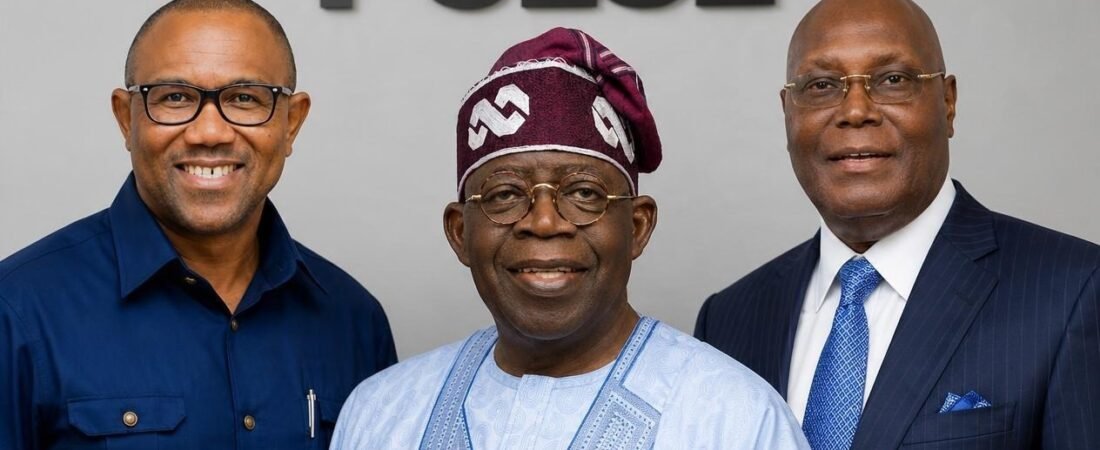

On Wednesday, at the launch of the APC presidential campaign council in Abuja, Vice President Kashim Shettima called Peter Obi “the master of bogus statistics.” It got a laugh in the room, and it will get plenty of retweets. It is also the kind of line that is easy to say and hard to check. So we checked.
Not just Obi. On 1 October, all three leading candidates for January’s election spoke to the country. President Tinubu gave his Independence Day broadcast. Atiku Abubakar published a State of the Nation address on X. Obi read his Independence Day address to journalists in Abuja. We took all three, pulled out every claim that came with a number or a measurable trend, and checked each one against the body that produced the data in the first place: the National Bureau of Statistics, the Central Bank, the Debt Management Office, the World Bank, UNICEF, the oil regulator and others.
The rule was the same for everyone. A claim is accurate if it matches the data, allowing for honest rounding. It is stretched if it points the right way but inflates the number by more than about ten per cent, or describes the data more kindly than it deserves. It is wrong if the data contradicts it. And where no reliable data exists, we say so instead of guessing.
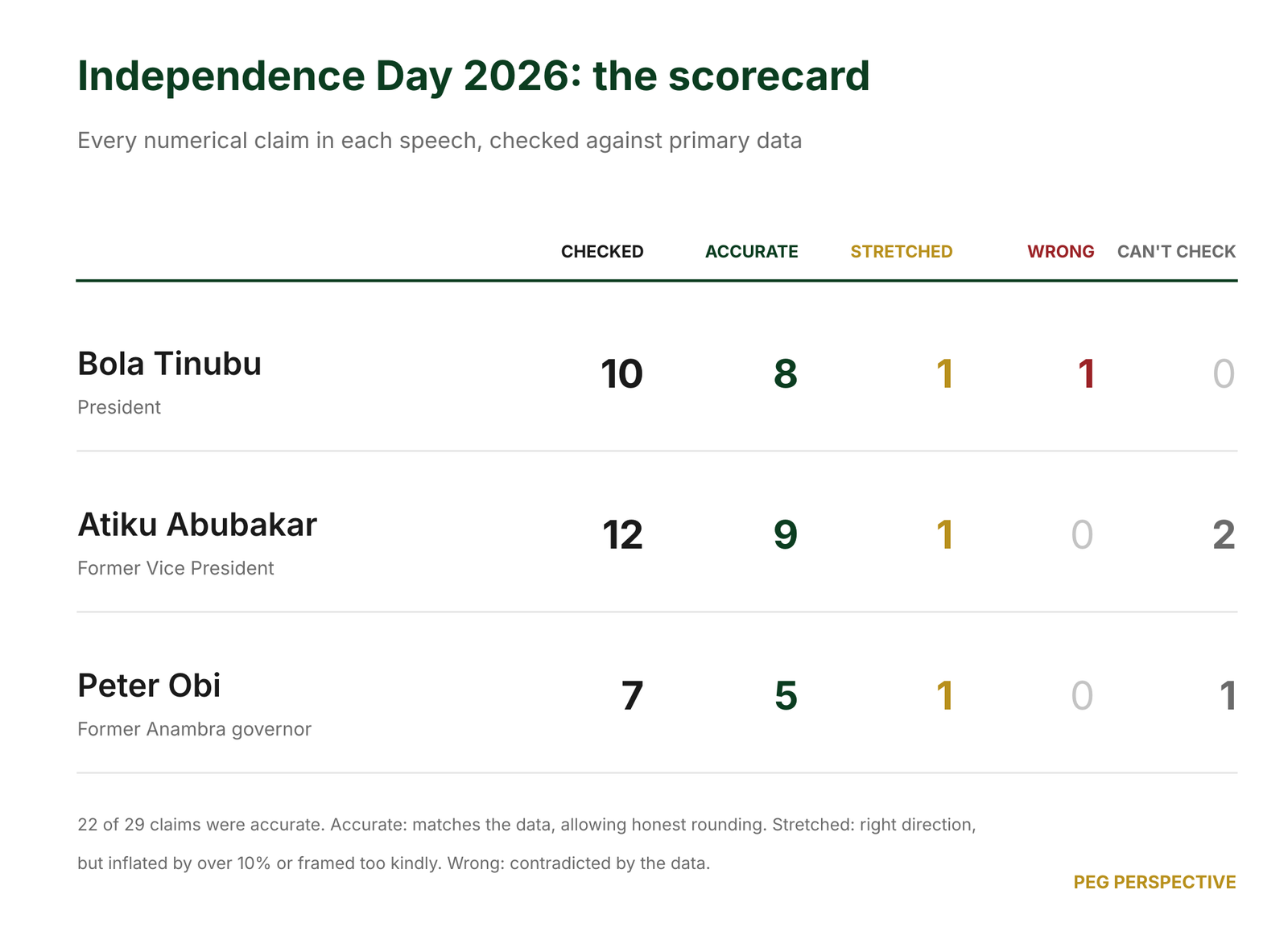
Here is the first surprise. None of them is lying to you. Of the 29 claims we checked, 22 hold up. Tinubu made ten checkable claims and eight were accurate. Atiku made twelve and nine were accurate. Obi made seven and five were accurate. If you came here hoping your man would walk away clean and the other two would be exposed, sorry. That is not what the numbers say.
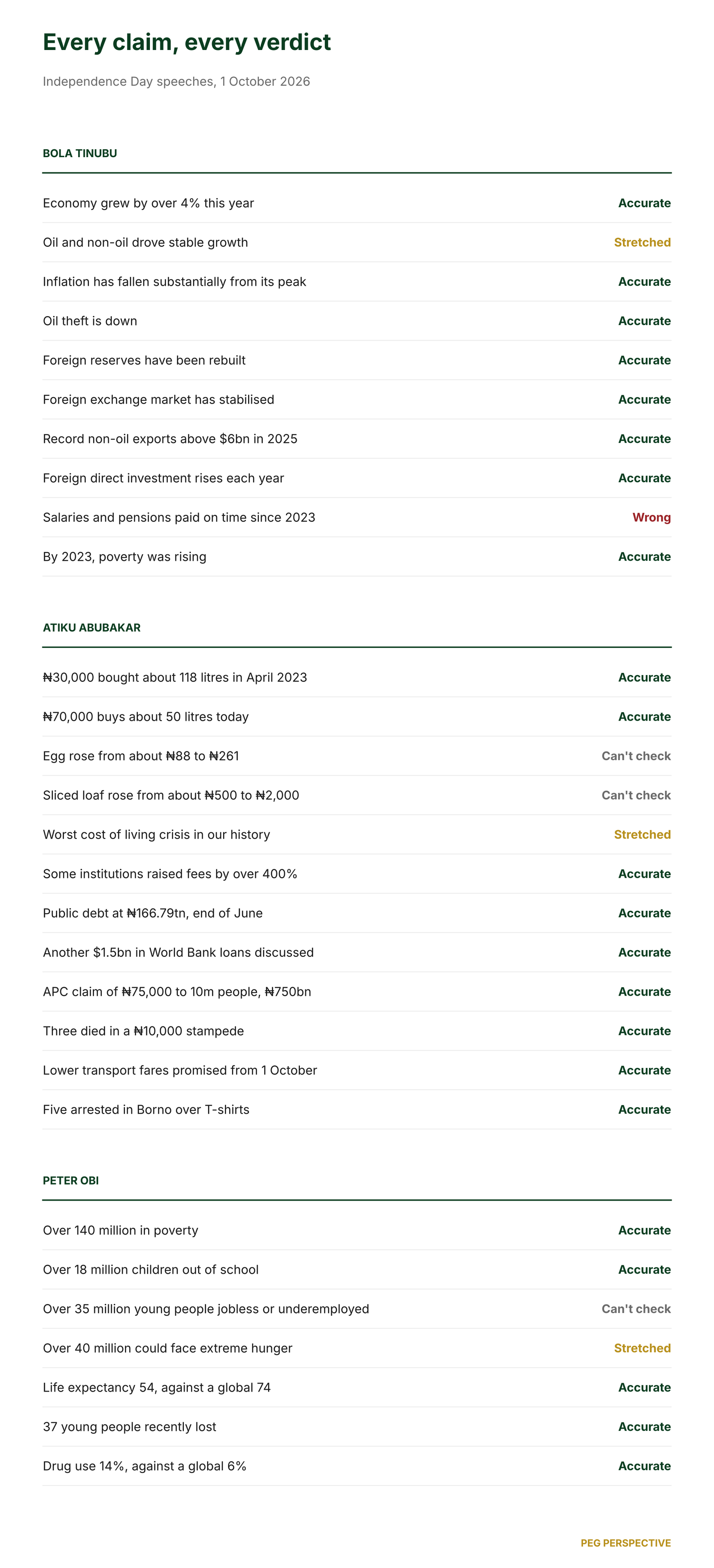
Tinubu’s one clear miss is the sentence that will sting most in the civil service. “Since 2023, we have paid salaries and pensions on time and in full,” he said. In March this year, the Office of the Accountant-General had to explain why February salaries for federal workers were late, and blamed a technical glitch. In July, federal workers were still complaining about unpaid months of the ₦35,000 wage award. It is a small line in a long speech, but it is a claim about millions of bank alerts, and the people who receive them remember.
His stretch is quieter. He said both oil and non-oil sectors had contributed to the “renewed period of stable growth.” Non-oil growth has indeed been steady. Oil has not. It grew 20.46 per cent in the second quarter of 2025, slowed to 2.57 per cent in the first quarter of this year, then jumped back to 7.31 per cent. That is many things. Stable is not one of them.
Everything else he said checks out. The economy grew 3.89 per cent in the first quarter of 2026 and 4.43 per cent in the second. Foreign reserves stood at about $35.09 billion when he took office and $54.86 billion on 24 September. Non-oil exports reached $6.1 billion in 2025, the highest the export council has recorded. Foreign direct investment rose from $377 million in 2023 to $675 million in 2024 and $923 million in 2025. Oil losses fell from about 102,900 barrels a day in 2021 to 9,600 between January and July 2025, though that is the newest public data, and it is now more than a year old.
Atiku’s petrol line holds up better than many people assumed. In April 2023, the NBS put the average price of a litre at ₦254.06, so a ₦30,000 minimum wage bought about 118 litres. In late September, NNPC stations were selling at between ₦1,385 in Lagos and ₦1,456 in Yobe, which means ₦70,000 buys roughly 48 to 51 litres. At least one published fact-check marked this claim only partly true, using an older national average. At the pump prices of the week he spoke, he was right.
His stretch is the big one. He called this “the most severe cost of living crisis in our history.” It is a brutal one, and nobody buying food in Nigeria needs a chart to feel it. But headline inflation peaked at 34.80 per cent in December 2024. In 1995, under Abacha, it was 72.84 per cent. Two of his claims we simply could not confirm: an egg going from about ₦88 to ₦261, and a sliced loaf going from about ₦500 to ₦2,000. The 2023 egg price matches NBS data from that period, but we could not find published NBS figures for May 2026 to confirm the other end of either comparison. That does not make them wrong. It means they are unshown.
Which brings us back to Obi, and Shettima’s line. Obi’s biggest number is solid. He said more than 140 million Nigerians live in poverty, and the World Bank’s April 2026 update puts 63 per cent of Nigerians below the national poverty line in 2025, about 140 million people. UNICEF counts 18.3 million children out of school. Nigerian life expectancy is about 54.6 years, against a global average of 73.3, so his “54 against 74” is honest rounding. His drug-use figure comes from the 2018 national drug use survey, the most recent of its kind, which found 14.4 per cent, against a global rate the UN now puts at 6.2 per cent. And the 37 deaths he mentioned are the miners who died in Civil Defence custody in Niger State last month.
But he said more than 40 million Nigerians could face extreme hunger by the end of this year. The Cadre Harmonisé, prepared by the government with the FAO, projected 34.7 million people in crisis-level food insecurity or worse for June to August 2026. That is already a catastrophe. Obi added five million to it. He also said more than 35 million young Nigerians are unemployed or underemployed, and there is no official figure that supports that. The most recent NBS labour force figures we could find, from 2024, put unemployment at 4.3 per cent and do not produce anything close to it. Both misses are big round numbers. That is a pattern his team should notice.
So is Obi the master of bogus statistics? On the evidence of this speech, no. Five of seven claims hold up, and his two weak ones are the kind of rounding up every campaign does. Criticise them, by all means. Criticise Tinubu’s salary line just as loudly.
The more useful lesson is not who scored highest. It is what each man chose to count.
Look at Tinubu’s list. Reserves, growth, exports, foreign investment, oil theft. All true. Not one of them is a price you pay at the market or the pump. Now look at Atiku’s. Litres, eggs, bread, debt, loans. Nearly all true, and almost entirely about what life costs, with nothing about what has improved. Obi’s list is poverty, out-of-school children, hunger, life expectancy and drug use. Human welfare, gathered to say the country is failing its people.
Each list is mostly true. Each is incomplete in exactly the way that suits the man reading it. Reserves have risen by nearly $20 billion since May 2023. Over the same period, total public debt has nearly doubled, from ₦87.38 trillion in June 2023 to ₦166.79 trillion in June 2026. Both facts are true at the same time. You will only hear one from each podium.
The clearest example sits inside a single sentence of the president’s speech. “By 2023, poverty was rising,” he said. Correct. The World Bank estimated at the time that poverty rose from 40 per cent in 2018 to 46 per cent in 2023. What the sentence leaves out is that, in its latest revised figures, the World Bank says poverty kept rising after he took office: 56 per cent in 2023, 61 per cent in 2024, 63 per cent in 2025. That 63 per cent is Obi’s 140 million. Same institution, same series. Both men quoted it accurately. One of them stopped at the year that suited him.
Between now and January, you will hear thousands of numbers. Most of them will be true. That is the trap. The question is rarely whether a number is real. The question is which number they decided not to say.
Ask for that one.
PEG Perspective is the writing arm of PEG Pulse.