
Nigeria didn’t fail as a country, it failed as a design.
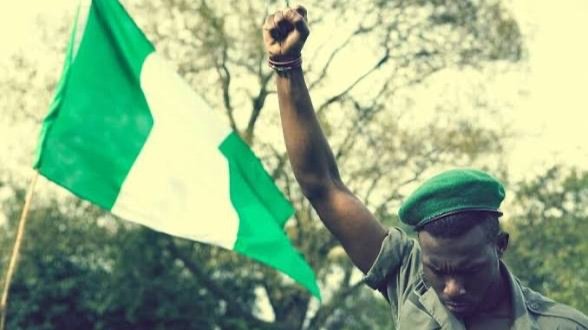
On October 1, 1960, the Union Jack came down over Lagos and a new flag went up. Nigerians celebrated an independence that had been decades in the making. But the country they inherited wasn’t built to survive its own success.
The British left behind a federation of three regions, North, East, and West, each dominated by a single ethnic bloc and a single political party. The North had the NPC and the Hausa-Fulani majority. The East had the NCNC and the Igbo majority. The West had the Action Group and the Yoruba majority.
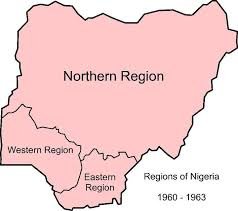
This wasn’t an accident of geography. It was the administrative logic of colonial rule, carried forward into self government without anyone seriously asking whether it could hold.
Sadly, it couldn’t.
The pushback wasn’t just political noise. The census commissioner himself, T. Warren, publicly criticized the figures as unrealistic. Under that pressure, Prime Minister Sir Abubakar Tafawa Balewa, in consultation with the regional premiers, cancelled the census results, and within two weeks a new five-member board was set up to conduct a fresh count.
Here is where the crisis stops being a story about bad data and becomes a story about who controls the machinery of the state. A national census, in any functioning democracy, is supposed to be a neutral administrative fact. In Nigeria in 1963, it became a negotiation between the Prime Minister and regional political leaders about what number the country was allowed to report.
The recount was conducted between 5 and 8 November 1963. When the results were released in early 1964, the numbers had shifted dramatically. The North was now recorded at 29.8 million, the East at 12.4 million, the West at 10.3 million, the Mid-West at 2.5 million, and Lagos at 675,352, an overall increase of 74 percent over the 1952 to 1953 baseline. The South’s brief statistical majority had vanished. The North’s dominance, and with it its share of parliamentary seats ahead of the 1964 federal election, was restored.
The Eastern and Mid-Western regional governments rejected the new figures and took the matter to the Supreme Court. They lost, and the federal government proceeded to accept the results anyway.
Think about what actually happened here. A count of human beings, an exercise that should be one of the most boring and technical functions a government performs, was cancelled once because the outcome favored one side, then rerun until it favored the other, then defended through the courts once it did. Both regions were accused of inflating their own figures during the process. Nobody in this story has clean hands. But the state’s institutions, the census board, the courts, the office of the Prime Minister, all bent to accommodate the outcome that regional power brokers needed, rather than holding the line on an honest count.
That is the pattern worth noting. Not simply that politicians lied about numbers, people in every country do that, but that Nigeria’s federal institutions, only three years into self-rule, proved willing to cancel an inconvenient truth and manufacture a convenient one. The 1964 election that followed was fought on a foundation everyone already knew was political theater dressed up as demography. It is little wonder that election collapsed into the crisis that came next.
The census crisis didn’t cause the coups of 1966 on its own. But it taught Nigeria’s political class a lesson they never unlearned: that state institutions could be made to produce whatever answer power required, and that the public would eventually be asked to accept it regardless.
If the census crisis taught Nigeria’s political class that state institutions could be bent to serve power, the western region crisis of 1962 taught them something worse; that federal power could be used to physically dismantle a rival government and the country would be made to accept it as necessary.
The trouble started inside the Action Group itself, the party governing the Western Region. Obafemi Awolowo, the party’s leader and head of the federal opposition, wanted the party to adopt a more radical, socialist direction, drawing on the example of Kwame Nkrumah’s Ghana. Samuel Ladoke Akintola, the Western Region’s premier and Awolowo’s deputy, pushed the opposite way: closer cooperation with the ruling Northern People’s Congress at the federal center. The disagreement became personal and then became a party crisis at the party’s convention in Jos in January 1962.
What followed was not settled through party structures. Awolowo’s faction moved to expel Akintola from the party. The regional governor, acting on Awolowo’s side, dismissed Akintola as premier on 21 May 1962. Akintola immediately filed a motion in the High Court challenging the Governor’s power to remove him that way. Before the court could rule on that motion, the Governor went ahead and appointed a replacement premier anyway. That unresolved legal limbo, a sitting court challenge ignored in favor of installing a new government, became the actual constitutional trigger for what followed. When the Western Region’s House of Assembly met to ratify the new government, the session collapsed into violence on the floor of the chamber. Police had to teargas the building and lock it down. A second attempt days later ended the same way.
On 29 May 1962, Prime Minister Abubakar Tafawa Balewa brought a motion to Federal Parliament to declare a state of emergency in the Western Region, arguing that no validly constituted government existed in the region at all. It passed by a wide margin. Awolowo objected on the floor that day, calling the emergency a violent assault on democratic institutions in Nigeria, and pointing out that comparable unrest elsewhere, in the Tiv Division and Okrika, had never triggered the same federal response. He lost the argument. A federal administrator was installed to run the region directly, and Action Group leaders, including sitting officeholders, were placed under restriction.
The emergency ran roughly six months. When it ended, Akintola, the man whose removal had triggered the entire crisis, was reinstated as premier, and formed a new party openly aligned with the federal government that had just intervened on his behalf.
Then came the part that turned a political defeat into something far more serious. On 2 November 1962, Awolowo and twenty-six others were charged with treasonable felony, accused of conspiring to overthrow the federal government. The trial before Justice George Sodeinde Sowemimo ran eleven months, with the prosecution presenting roughly 800 pages of evidence. In September 1963, Awolowo was convicted on three separate counts: ten years with hard labor for treasonable felony, five years for conspiracy to commit felony, and two years for conspiracy to effect an unlawful purpose, served concurrently at ten years.
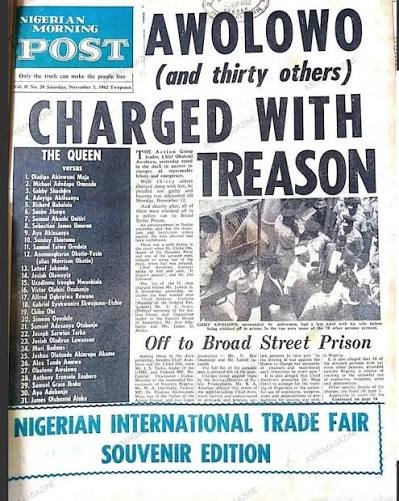
Sowemimo, sentencing him, said from the bench that his hands were tied, that convicting younger co-defendants while sparing Awolowo would look like favoritism. Awolowo, in his statement before sentencing, told the court directly that he rejected the verdict, while still thanking the judge for his conduct of the trial.
This wasn’t a conviction that went unexamined. Five Supreme Court justices unanimously upheld it in 1964. A parallel case, the treason trial of Anthony Enahoro on the same underlying facts, had run two weeks earlier and ended in a fifteen year sentence, later cut to seven on appeal. The judiciary validated the entire episode at every level it touched, which matters for who actually bears responsibility here. This wasn’t one Prime Minister’s overreach. It was a state apparatus, executive, judiciary, and the machinery of an emergency law, all converging to remove an opposition leader through channels each participant could call legitimate.
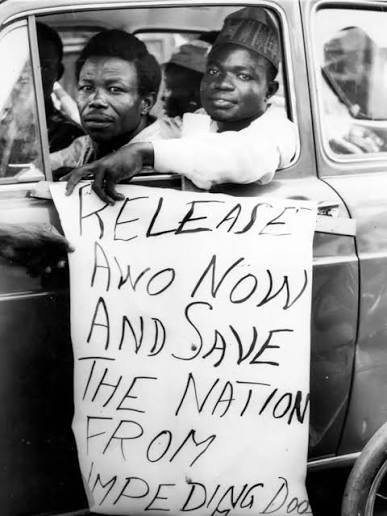
Awolowo served roughly four years before his release in 1966, after the coup that ended the First Republic, under the military government that followed. He outlived the government that jailed him. The tool that government built to break him, emergency powers and selective prosecution deployed against political rivals, did not die with it. Every government since then has reached for some version of the same playbook.
Two alliances contested the poll. The Nigerian National Alliance brought together the Northern People’s Congress, Akintola’s Nigerian National Democratic Party, and several minority parties, led by Ahmadu Bello, the Sardauna of Sokoto and premier of the Northern Region. Against them stood the United Progressive Grand Alliance, formed in June 1964 at Ibadan, combining the National Council of Nigeria and the Cameroons, the remnants of the Action Group, and northern minority parties, led by Michael Okpara, premier of the Eastern Region. Obafemi Awolowo, the Action Group’s actual leader, contested none of it directly. He was in Calabar prison, serving the sentence from the previous piece in this series, while his party fought a national election without him.
The campaign itself barely qualifies as an election in any functional sense. Electoral officers in the North reportedly made themselves unavailable to receive nomination papers from opposition candidates, and by the time nominations closed, 88 of 174 northern seats had been declared unopposed. Akintola’s machine in the West used similar tactics to declare roughly 30 percent of western seats unopposed as well. Opposition candidates in several places were reportedly beaten, detained, or worse during the campaign.
Faced with an election already decided before voting began, the United Progressive Grand Alliance called for a boycott. President Nnamdi Azikiwe, largely a ceremonial figure under the 1963 republican constitution but the country’s most senior elected office holder, agreed the irregularities were serious enough to justify postponing the poll. Prime Minister Balewa disagreed and ordered the election to proceed on 30 December as scheduled. Two members of the Federal Electoral Commission, representing the East and Midwest, resigned in protest rather than oversee it.
Voting on 30 December was not countrywide in any meaningful sense. The boycott was total in the East and nearly total in Lagos. Voting went ahead in parts of the West and Midwest, and across the North with only isolated pockets of boycott. The Nigerian National Alliance declared a resounding victory from an election roughly half the country had refused to participate in.
Then came the part that turned an unfair election into a constitutional crisis. Tafawa Balewa asked Nnamdi Azikiwe, as president, to formally invite the winning alliance to form a government, the standard procedure. Azikiwe refused. For three days, Nigeria had no functioning process for actually seating a federal government, the two most senior officials in the country had an open impasse over whether an election this compromised deserved to stand. Azikiwe eventually relented and issued the invitation. No court settled it. No independent process resolved it. It ended because one man backed down after three days of deadlock.
Supplementary elections were held in March 1965 in the constituencies that had boycotted in December. The final tally gave the United Progressive Grand Alliance 108 seats against the Nigerian National Alliance’s 189, a majority built substantially on an election process the opposition had refused to recognize as legitimate in the first place.
The damage didn’t stop at the federal level. In October and November 1965, the Western Region held its own regional election, and the same machinery ran again, this time with even less restraint. Akintola’s party was declared the winner despite being, by most accounts, deeply unpopular in the region it claimed to have won. The result triggered what became known as Operation Wetie, weeks of arson and killing across Yoruba towns, with death tolls estimated in the hundreds to low thousands and thousands of homes burned. Relations between Balewa and Azikiwe, already damaged by the federal crisis, never recovered.
Two months after that, in January 1966, Nigeria’s first military coup ended the republic entirely.
Look at the sequence, an election run through intimidation and unopposed seats. A boycott the government chose to override rather than address. A constitutional deadlock resolved by one man’s capitulation rather than any institutional process. A regional election that repeated all of it and triggered mass violence. Nobody who lived through 1964 and 1965 could have been surprised that January 1966 arrived next. The coup didn’t interrupt a functioning democracy. It arrived at the end of eighteen months in which Nigeria’s political class had already demonstrated, repeatedly and in public, that elections were something to be managed rather than honored.
In the early hours of 15 January 1966, a group of army majors led by Chukwuma Kaduna Nzeogwu in Kaduna and Emmanuel Ifeajuna in Lagos launched a coordinated mutiny. By the time it ended, 22 people were dead. Prime Minister Abubakar Tafawa Balewa was killed. So was Festus Okotie-Eboh, the Finance Minister. So was Ahmadu Bello, the Sardauna of Sokoto and premier of the Northern Region, shot by Nzeogwu himself inside his own residence, in front of his wives and children, after the compound was shelled and set ablaze. Samuel Akintola, the Western premier was also killed. So were several of the army’s most senior northern officers, including Brigadier Zakariya Maimalari and the Army Chief of Staff, Colonel Kur Mohammed.
President Azikiwe survived. Eastern premier Michael Okpara survived. The plotters themselves were mostly, though not entirely, Igbo officers, and what they actually intended, a genuine national reform or something narrower. What mattered politically was simpler and more dangerous: the list of who died and who didn’t mapped almost exactly onto a north-south, Hausa-Fulani-versus-Igbo line. Intent stopped mattering, perception took over.
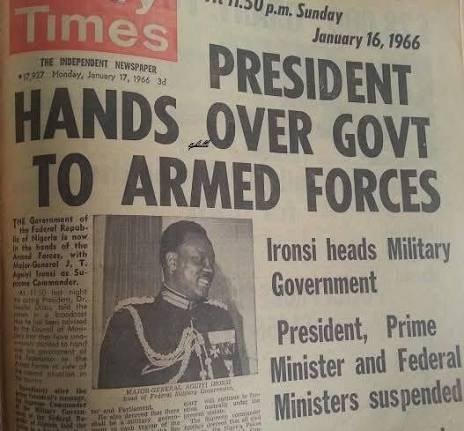
The coup itself failed to seize full control. Major General Johnson Aguiyi-Ironsi, the army’s most senior officer and himself Igbo, suppressed the mutiny within a day and assumed power as head of state on 16 January. This is the moment the republic could have course corrected toward some kind of accountability. It didn’t. Ironsi moved slowly against the January plotters, and in May 1966 his government issued the Unification Decree, abolishing Nigeria’s federal structure in favor of a single unitary civil service. To northern political and military elites already primed to see the January coup as an Igbo power grab, the decree read as confirmation: first they killed our leaders, now they’re erasing the federal structure that protected our autonomy. Anti-Igbo riots broke out across the North that same month.
On 29 July 1966, northern officers led by Lieutenant Colonel Murtala Muhammad staged a counter-coup. Ironsi was arrested by Lieutenant Colonel T. Y. Danjuma for refusing to act decisively against the January conspirators, then killed along with Brigadier Adekunle Fajuyi, his host in Ibadan at the time. Lieutenant Colonel Yakubu Gowon, chief of staff to Ironsi, was installed as head of state at 31 years old, not because he led the coup but because, by his own later account, the officer who likely would have taken the role, Maimalari, had already been killed in January.
The counter coup did not stay confined to Lagos barracks. It opened into massacres of Igbo soldiers and, over the following months, thousands of Igbo civilians across the North, a wave of violence that drove a mass exodus of Igbo families back to the Eastern Region and set the direct path towards Biafra’s declaration and the civil war that followed in 1967.
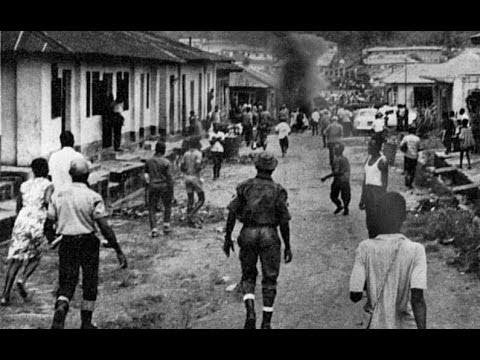
Nigeria didn’t drift into military rule. It was pushed there by a republic that had already shown repeatedly and on the record that it couldn’t govern itself through it’s own institutions.
A federal structure that made ethnic and regional competition the operating logic of government from 1960 onward. A center that learned in 1962 it could use extraordinary power ti break rivals it couldn’t beat politically. An election in 1964 run as an exercise in managing outcomes rather than counting votes. Each of those failures taught Nigeria’s political and military class the same lesson in a different register; that institutions bend to whoever controls them, and that violence is an available tool once political channels are treated as negotiable. January and July 1966 are not where the lesson started, they’re where it detonated.
The first republic didn’t fall because Nigerians were incapable of self government. It fell because the structures inherited at independence, and the choices made inside them for six years, gave every ambitious actor, civilian and military alike, a working example of how to seize what they wanted by force once persuasion and process stopped working.