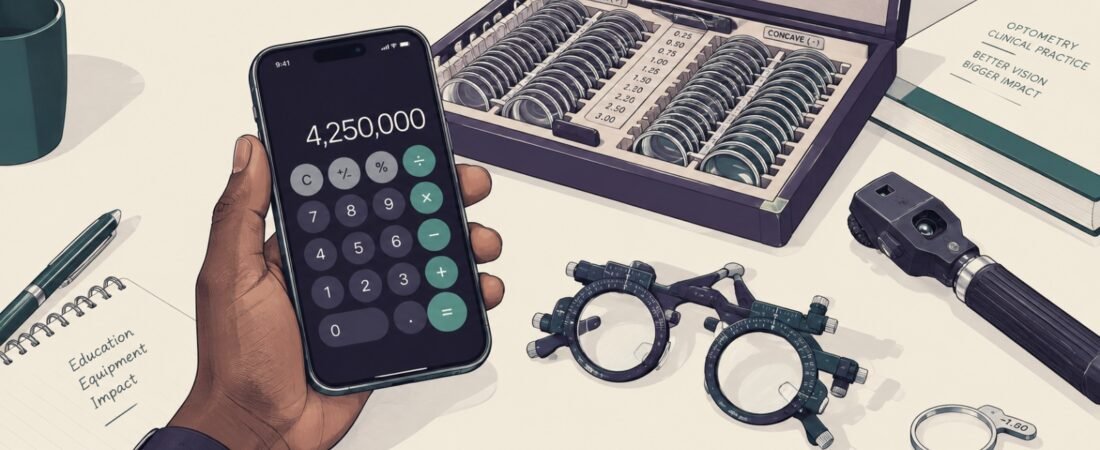

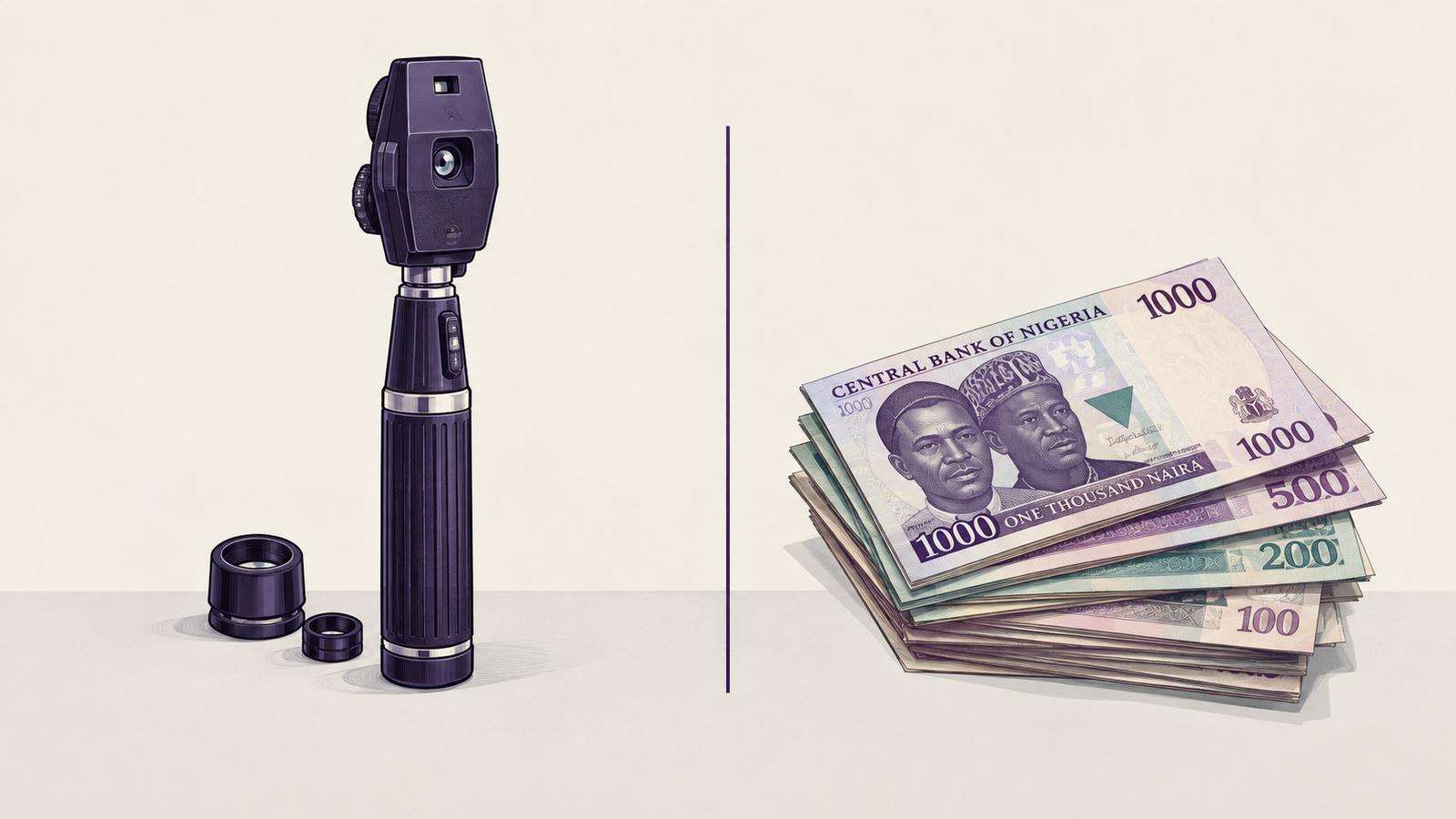
A few months into my fourth year, I called a medical equipment vendor to ask what a full set of clinical instruments would actually cost. I wasn’t shopping casually. In Nigerian optometry schools, fourth year is when the theory ends and the real bill arrives. He ran through the list, direct ophthalmoscope, retinoscope, trial lens set, tonometer, slit lamp accessories, and quoted a total of ₦1.6 million. That was his price then.
Given how the naira has moved since, it is almost certainly higher now.
I remember sitting with that number for a while. Not because I hadn’t expected some cost, every clinical health course has one, but because of what it represented next to everything else already spent, and everything still owed.
A Curriculum Built for Endurance

Getting into optometry school in Nigeria already asks a lot. A high JAMB score and a strong Post-UTME result are the entry price, and once inside, the six-year Doctor of Optometry programme runs students through the same foundational medical sciences as their medical and dental counterparts, physiology, anatomy, biochemistry, often in greater depth in specific areas, before narrowing into ocular health specifically by third year. It is, in effect, the front-loaded curriculum of a broader medical degree compressed to make room for genuine specialisation later.
Third year brings the first real financial checkpoint: ODORBN indexing.
The fee currently sits at ₦50,000, up from ₦30,000 in earlier cohorts, and it carries real consequences if missed.
Failing to pay in third year attracts a 50 percent surcharge the following year, compounding again the year after.
Left unresolved, it can delay induction and licensure itself, the final, formal step that allows a graduate to actually practice.
The Real Weight: Clinical Instruments
None of that compares to what comes in fourth year, when clinical training genuinely begins. Many schools and lecturers hold students to a standard built around premium diagnostic brands like Keeler, often declining to accept more affordable alternatives even when they are clinically capable. Schools frequently claim to provide these instruments through school fees, but a persistent sharing gap means many students never get reliable access to what they’re told is already covered.
This isn’t anecdotal.
In 2025, OPTOGLOBE, the Global Optometry Student Community, together with Optometry Giving Sight, launched Equipping the Future, ETF, an initiative built specifically to assess and address this gap.
Its Global Needs Assessment survey reached optometry students across 13 countries, and the findings are stark.
69 percent of respondents own no personal diagnostic equipment.
59 percent say their school provides none either.
87 percent have never heard of a grant scheme that could help.
96 percent support creating one.
The retinoscope, one of the most basic tools in the profession, is the single most requested item.
Most students in training lack the basic diagnostic tools their profession depends on, and this gap shapes the quality of clinical education long before students reach independent practice.
How America Handles the Same Problem
It’s worth looking at how a wealthier system absorbs a similar cost. In the United States, optometry students also pay for their own instruments, but the framing is different.
At SUNY College of Optometry, for instance, students purchase instrument sets in clearly itemized stages, roughly $2,000 in one year and $4,800 in another, disclosed openly rather than buried inside a vague fee. Critically, these costs sit inside the same financial aid package as tuition itself, meaning students can borrow against them through the same federal loan process, rather than sourcing a separate lump sum from a vendor with no financing option at all.
The scale of US tuition itself is genuinely larger.
Average tuition and fees for a Doctor of Optometry programme run around $39,550 a year for residents and $45,472 for non-residents, and total cost of attendance across the full four-year programme, including living expenses, typically lands between $160,000 and $280,000.
Against that, the median annual salary for US optometrists was $134,830 as of 2024, according to the Bureau of Labor Statistics.
Run the numbers plainly: total tuition costs roughly equal to one, maybe one and a half years of a graduate’s actual salary. Spread across a standard ten-to-twenty-year federal loan term, that debt is genuinely serviceable, uncomfortable, certainly, American optometry graduates carry real debt loads, but structurally repayable against a starting income that can absorb it.
The Nigerian Reality Doesn’t Match
Now hold that against Nigeria. Tuition at public institutions is comparatively modest, typically ranging from ₦60,000 to ₦200,000 depending on the school. On paper, that looks like the easier system. It isn’t, because tuition was never the actual burden. The instruments are.
Entry-level optometrist salaries in Nigeria are difficult to pin down precisely, market data is thin and inconsistent, but figures commonly cited for fresh graduates sit around ₦150,000 a month, roughly ₦1.8 million a year, before rent, feeding, transport, or anything else. Against that income, a ₦1.6 million instrument bill isn’t a manageable graduate debt. It’s very close to an entire year’s gross salary, paid upfront, often before a single naira of that salary has been earned, frequently borrowed informally from family rather than through any structured, interest-free channel built for this exact purpose.
Even under generous assumptions, a graduate setting aside a genuine, sustainable share of take-home pay toward this cost alone, while still covering rent, feeding, and transport, is realistically looking at several years just to clear it. That’s before any tuition already paid is factored back in.
A Policy Limited to the Least Burden
This is where Nigeria’s own solution, on paper, misses the actual problem.
The Nigerian Education Loan Fund, NELFUND, now covers tuition directly to the institution, plus an optional ₦20,000 monthly upkeep stipend, interest-free, repayment deferred until after NYSC and employment. It is a genuinely good policy for what it targets. But it targets tuition, the ₦60,000 to ₦200,000 side of the ledger, while leaving the ₦1.6 million instrument wall entirely untouched. For optometry students specifically, NELFUND is solving the smaller problem and leaving the larger one exactly where it was.
The Human Cost Shows Up in the Data Too
This financial pressure doesn’t sit in isolation from how students are actually doing.
A 2026 national study published in PLOS One, surveying 474 optometry students across ten Nigerian universities, found that 51.1 percent experienced depressive symptoms and 61.8 percent experienced anxiety, with a quarter of respondents experiencing all three, anxiety, depression, and stress, at the same time.
A separate 2024 study focused specifically on students at the University of Benin found comparably high rates: 40.2 percent depression, 51.2 percent anxiety, 35.5 percent stress. Neither study isolates instrument costs as a single cause, mental health is rarely that simple, but both point to the same underlying pattern the ETF data already suggested: a training system carrying real, sustained financial strain on the people moving through it.
What I Think
I don’t think the answer is lowering clinical standards. Good diagnostic training genuinely requires real instruments, used repeatedly, by the student who will eventually rely on that skill independently. But the current standard conflates “rigorous” with “expensive,” and those aren’t the same thing. Devices like the Arclight, and other validated, low-cost pocket ophthalmoscopes and retinoscopes, already meet real clinical need at a fraction of the cost some schools insist on. Curriculum standards should explicitly permit them, not treat them as a compromise.
Beyond that, I think this needs dedicated funding built specifically around instruments, not folded vaguely into general tuition support. A grant model with direct instrument delivery, rather than cash disbursement that competes with rent and feeding, would close the actual gap ETF’s data describes. It would also pay forward: a student who owns real instruments through school graduates with sharper clinical skill, and walks into locum work immediately able to practise, rather than borrowing equipment from a former classmate.
And I think NELFUND’s scope deserves an honest second look. For optometry students specifically, the ₦60,000 to ₦200,000 tuition band was never the real crisis. The ₦1.6 million instrument wall is. A loan scheme built to prevent financial dropout should recognise where that dropout risk actually concentrates.
So, is optometry education at its current standard genuinely a sound investment in Nigeria? Or would a student, purely on the numbers, be better served putting that same ₦1.6 million into something like the Dangote Refinery IPO, currently open at ₦525 a share through October 13, 2026, enough for roughly 3,000 shares? I want to be careful here: that isn’t investment advice, share prices move, IPOs carry real risk, and I’m not a financial advisor but the fact that the comparison is even worth making, that a stock purchase and six years of medical training can be weighed on the same scale, says something uncomfortable about where the real cost of this profession actually sits.