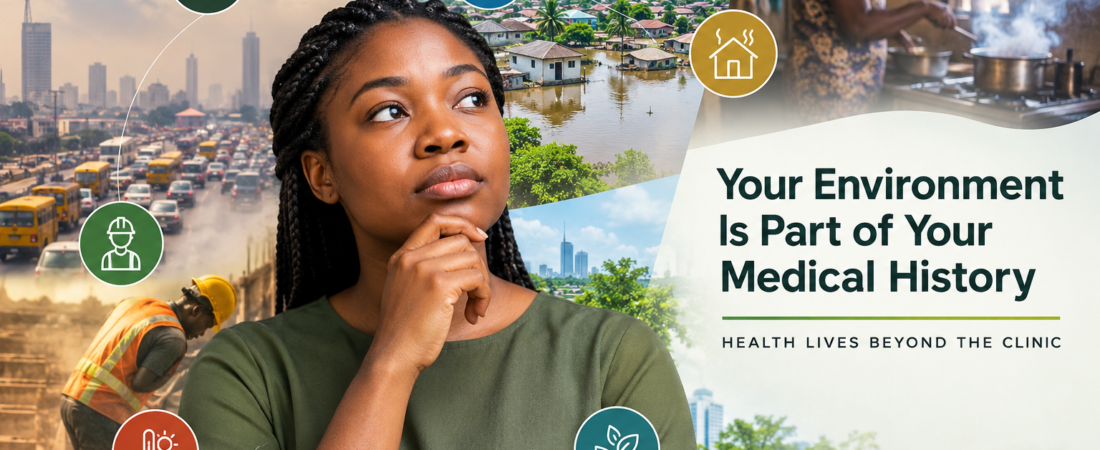

When we think about our medical history, we usually think about illnesses, medications, allergies, family history and previous treatments.
But there is another part of our health history that is often overlooked: our environment.
Where you live, what you breathe, where you work, what you are exposed to at home and the climate around you can all influence your health. You may not consider traffic, workplace conditions, poor ventilation, extreme heat or inadequate sanitation to be part of your medical history. But your body experiences these conditions every day.
This raises an important question: Could the environment in which you live be telling part of your health story?
In this edition of PEG Perspective, we explore how the places and conditions around us can shape our health and why environmental health deserves a place in that conversation.
1. Your Address Can Tell a Health Story
When a doctor asks about your medical history, you may mention previous illnesses, medications, allergies and family history.
But there is another question that deserves attention:
Where do you live?
Your address is more than a location. It can determine the environmental conditions you are exposed to every day.
Consider a person living near a busy highway in Lagos, in an area prone to frequent flooding, or in a community where waste disposal and access to clean water are ongoing challenges. Now consider another person living in a well-ventilated neighborhood with reliable water, sanitation and access to green spaces. These are not simply differences in lifestyle. They are differences in exposure.
Your neighborhood can shape the air you breathe, the water you use, your exposure to heat and noise, and even how easily you can access healthcare and healthy food.
This is one reason why people in similar circumstances can still experience very different health outcomes. Sometimes, the difference is where they live.
So when we think about medical history, maybe we should ask more than:
“What has happened to your body?”
We should also ask:
“What has your environment been exposing your body to?”
Your address may not appear on your medical chart, but it can tell an important part of your health story.
2. What You Breathe Matters
You take thousands of breaths every day without thinking about it.
But what exactly are you breathing?
Air can carry smoke, dust, particulate matter, chemicals and other pollutants. Some exposures are obvious, such as cigarette smoke or industrial emissions. Others are so common that we barely notice them cooking with firewood or charcoal in a poorly ventilated space, spending hours in Lagos traffic surrounded by vehicle exhaust and dust, or working amid roadside trading, burning waste and fumes.
Across Nigerian cities, people experience different forms of everyday environmental exposure. In Abuja, people may spend long periods commuting along busy roads or working outdoors in dusty environments. In Port Harcourt, industrial and petroleum-related activities make environmental exposure an important public health concern. In Kano, dust and dry conditions form part of the environmental context many people experience. In cities such as Ibadan, Benin City and Onitsha, traffic, dust, waste burning and other urban activities can also influence the air people encounter.
The point is simple: where you live and how you move through your city can influence what you breathe.
You breathe. You work. You commute. You cook. You sleep. And you repeat the cycle.
Exposure can become part of everyday life.
So instead of asking only, “Do you smoke?”, maybe we should also ask:
“What do you breathe every day?”
Because sometimes, the health risk isn’t something you chose to consume.
It is simply the air around you.
3. Your Workplace Is Part of Your Health History
We spend a significant part of our lives at work, yet we rarely consider our workplace when thinking about our health history. Many people do not realize that where you work and the exposures you encounter in your workplace can have significant effects on your health over time.
A construction worker may encounter dust, noise and extreme heat. A laboratory worker may handle chemicals or biological materials. A mechanic may be exposed to fumes and solvents. A healthcare worker may encounter infectious agents and other occupational hazards.
Even an office worker may experience health effects from prolonged sitting, poor ventilation, repetitive tasks, inadequate lighting or workplace stress.
So the question isn’t only:
“What do you do for a living?”
It should also be:
“What does your work expose you to?”
Your job provides your livelihood, but your working environment can also become part of your health story.
4. Climate Is Becoming a Health Issue
Climate change is often discussed in terms of rising temperatures, extreme weather events and environmental degradation. But its implications extend beyond the environment. It is increasingly a public-health concern.
Extreme heat can increase the risk of dehydration, heat exhaustion and heatstroke, while prolonged exposure can place additional strain on the body. In Nigeria, this is particularly relevant for people who work or spend significant time outdoors, including farmers, construction workers, traders and transport workers.
Flooding also presents its own health concerns. It can contaminate water sources, damage homes, disrupt healthcare services and increase exposure to certain infectious diseases.
However, the health effects of climate change are not felt equally. Occupation, housing conditions, income and location can all shape a person’s level of exposure and vulnerability.
Climate change, therefore, is not simply an environmental issue.
It is a growing public health issue that affects the conditions in which people live, work and maintain their health.
5. Environmental Health Isn’t Only About Pollution
When people hear “environmental health,” they often think of air pollution, contaminated water, waste or industrial chemicals.
These are important, but environmental health is much broader.
It concerns the conditions in which people live, work and grow including housing, sanitation, access to clean water, transportation, safety, climate, green spaces and access to healthcare.
Is your neighborhood exposed to extreme heat or flooding?
Can you safely walk or exercise outdoors?
Do you have access to clean water and adequate sanitation?
Is your home properly ventilated?
Do you live in a safe and healthy environment?
These are environmental questions, but they are also health questions.
This connects environmental health to the social determinants of health. The conditions that shape people’s opportunities to achieve and maintain good health. It also reflects several Sustainable Development Goals, including SDG 3: Good Health and Well-being, SDG 6: Clean Water and Sanitation, SDG 11: Sustainable Cities and Communities, and SDG 13: Climate Action.
Ultimately, health is not created in hospitals alone. The environments in which we live can influence how healthy we are able to be.
The air we breathe, the work we do, the homes we live in, the climate we experience and the conditions within our communities all contribute to our health story.
Maybe a complete understanding of someone’s health requires us to look beyond their symptoms, medications and family history and ask one more question:
What has their environment been exposing them to?
Because if our environment can influence our health, shouldn’t it be considered part of our medical history?
This article was written by Pemiga Gadimoh. She writes on public health, environmental health, healthy living, and the factors that shape our health and well-being.