
Most of what gets said about the African Medical Centre of Excellence in Abuja is about the building, the equipment and the specialists flown in from London. The most important number its chief executive gave PEG Dialogues this week was about none of those things.
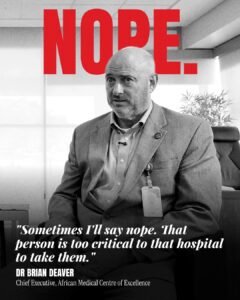
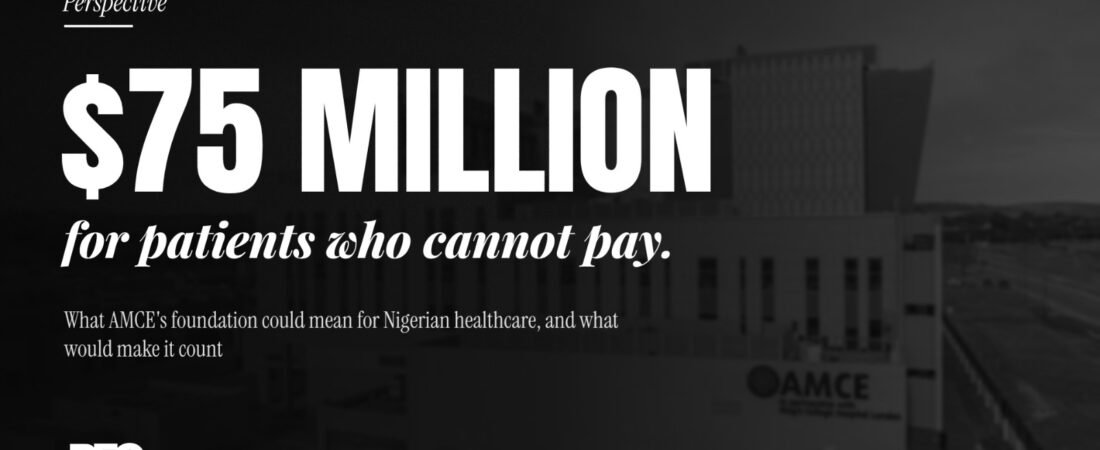
Dr Brian Deaver says the hospital’s foundation now holds about $75 million. That figure, he said, does not include commitments from Novartis, the Dangote Foundation, the Gates Foundation and others. He described three jobs for the money: subsidising care for patients who cannot afford it, funding research and clinical trials, and paying for equipment the hospital suddenly finds it needs. “We’d never turn the patient away,” he said, and when a patient cannot pay, “we always work out arrangements.”
That is a large sum by any measure. In February 2025, months before the hospital opened, BusinessDay reported that the same foundation had raised about $6 million. If Deaver’s figure holds, the fund has grown more than tenfold in under two years. It deserves attention, and it deserves questions.
The reason it matters is simple. In Nigeria, people still pay for most of their own healthcare at the point of need. The government’s latest National Health Accounts, released in December 2025, put out-of-pocket spending at 58.3 percent of total health expenditure in 2024. That is an improvement on the years when it sat above 70 percent, but it still means more than half of what the country spends on health comes straight from patients’ and families’ pockets. Government spending was just 12.4 percent of the total.
Insurance has not filled the gap. The National Health Insurance Authority said in September that enrolment had passed 23 million people. In a country Deaver himself describes as home to 230 million, that is roughly one person in ten.
For the other nine, a cancer diagnosis or a heart operation is a family financial event. When Nigeria Health Watch looked at AMCE soon after it opened in June 2025, it noted that a single radiotherapy session could cost more than ₦600,000 and asked the obvious question: would the hospital serve ordinary Nigerians or mainly those who could already afford premium care? A foundation of $75 million is the most serious answer AMCE has given to that question so far.
But a fund only helps the patients who know it exists, and that is where the work begins. Deaver himself said that one of AMCE’s biggest challenges is “getting the word out that we’re here,” because the Medical and Dental Council limits how hospitals can advertise. If the hospital struggles to tell Nigerians it exists, the foundation inside it is even harder to find.
Three things would turn a large number into a public good that people can trust. The first is a clear front door: published criteria for who qualifies for support, and a simple way to apply that does not depend on knowing someone. The second is a regular public account of what the money did, such as how many patients were supported, for which conditions, and how much went to care rather than to research or equipment. Splitting one fund across three purposes is sensible, but patients and donors deserve to see the split. The third is a link to the systems patients already use. Deaver said AMCE works with the NHIA and with patient advocacy groups. The more the foundation’s support sits on top of insurance and referral pathways, the further each dollar goes.
None of this is a criticism of what AMCE has built. It is what any fund of this size should expect, and the hospital’s own backers, from Afreximbank to the Gates Foundation, ask the same of the projects they finance.
There is also a lesson here beyond one hospital. Nigeria’s health financing debate usually swings between two poles: government should pay, or patients will. AMCE is testing a third path, in which a hospital that charges market prices for most services also builds a pool of donor and corporate money to carry the patients who cannot pay. Teaching hospitals, federal medical centres and private specialist hospitals across the country could learn from it, if it works and if its results are published.
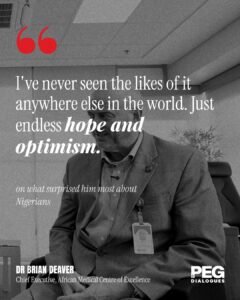
Deaver told PEG Dialogues that he wants Nigerians to see AMCE’s building “as a beacon,” not as a place built for someone else, and that “everyone should be able to receive treatment regardless of their ability to pay.” The $75 million foundation is the part of the hospital that will decide whether that line is a promise or a slogan. The money now exists. What happens next is a matter of reach and openness, and patients should be able to see it.
Figures on the AMCE Foundation are as stated by Dr Deaver to PEG Dialogues on 16 October 2026 and have not been independently verified.